

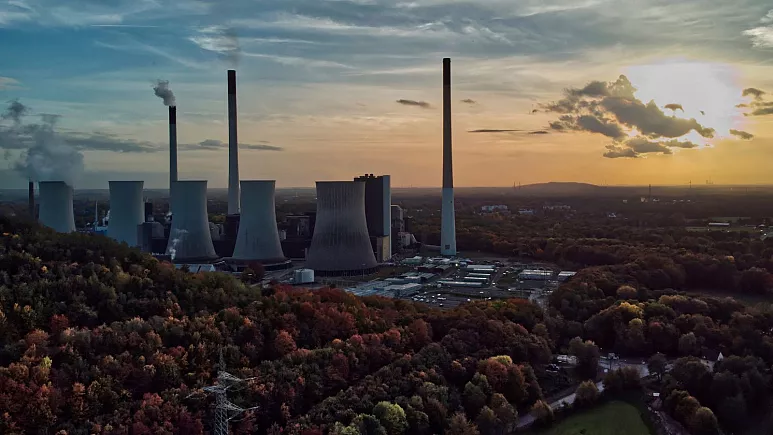
Germany’s status as the worst-performing major developed economy is a recent and unexpected development. The root of this shift can be traced to Russia’s invasion of Ukraine, which resulted in the loss of Moscow’s cheap natural gas. This event had an unprecedented impact on Germany’s energy-intensive industries, historically the backbone of Europe’s manufacturing sector. The sudden underperformance has ignited a wave of concerns and debates about the nation’s economic path forward.
The risk of “de-industrialization” looms large as high energy costs and government inaction on long-standing issues threaten to drive new factories and high-paying jobs to other regions. Christian Kullmann, CEO of Evonik Industries AG, one of Germany’s major chemical companies, expressed this concern, emphasizing the damage caused by the loss of cheap Russian natural gas to the German economy.
As Germany navigates the long-term consequences of its economic shift, a variety of challenges come into focus. The nation is grappling with soaring energy costs, stemming from the higher price of gas, which is nearly double what it was in 2021. This surge in energy prices impacts industries that rely on constant high temperatures, such as glass, paper, and metal coatings used in construction and automotive manufacturing.
Furthermore, Germany’s close trade ties with China, which has recently experienced an economic slowdown after decades of robust growth, have dealt another blow to its economic outlook.
Several long-standing issues have resurfaced, including a lag in the adoption of digital technology in government and businesses, sluggish approval processes for renewable energy projects, and a shortage of skilled labor. Delays in infrastructure investments, such as roads and rural high-speed internet, have also come under scrutiny. Additionally, the decision to shut down nuclear power plants in 2011 has raised concerns about electricity prices and supply shortages.
Germany’s reliance on Russian gas through the Nord Stream pipelines under the Baltic Sea has proven to be a mistake, with the supply disrupted amid the ongoing war. The transition to clean energy is impeded by bureaucratic hurdles and resistance from local communities, hindering the construction of wind turbines and power lines.
In response to these challenges, companies are exploring alternative energy sources, such as wind power and emissions-free hydrogen, although significant scale-up efforts are required. Chancellor Olaf Scholz has called for urgency in the energy transition, akin to the swift establishment of natural gas terminals following the loss of Russian gas.
Germany’s remarkable economic success over the past decades has encountered significant headwinds, threatening its position as a global economic powerhouse. Short-term challenges, including high energy costs and reduced access to cheap Russian gas, have exposed long-term issues like infrastructure gaps and the need for a faster transition to renewable energy. Addressing these challenges will require swift and effective government policies and industry innovations to ensure that Germany regains its economic vitality and remains competitive on the world stage.


