

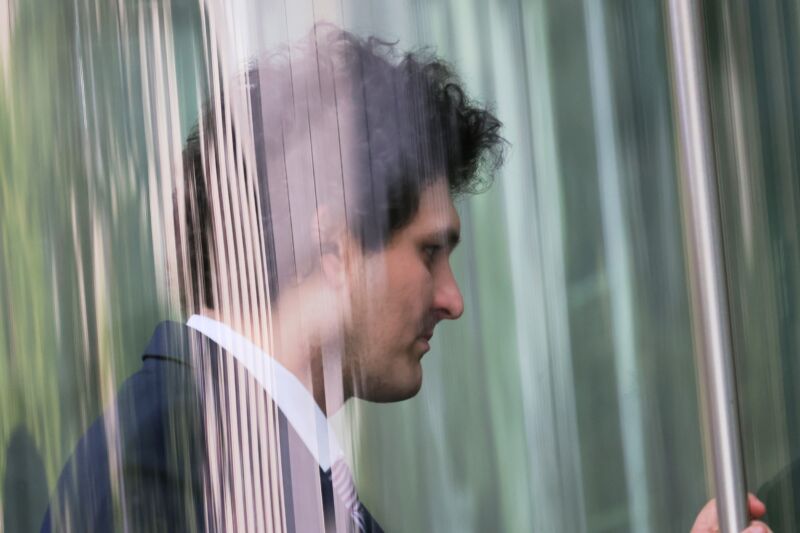
The closing chapter in the legal saga of Sam Bankman-Fried is unfolding, and the situation does not bode well for the entrepreneur. In the closing statement delivered by Nicolas Roos during today’s proceedings, the prosecution presented substantial contemporaneous written evidence that strongly implicated Bankman-Fried in wire fraud and conspiracy charges related to his involvement with FTX. Roos asserted, with confidence and restraint, that Bankman-Fried had essentially utilized FTX customer deposits as his personal financial reservoir, channeling these funds through his trading firm, Alameda Research.
The prosecution’s argument also emphasized the root cause behind Bankman-Fried’s actions: greed.
Bankman-Fried, the founder of the now-defunct cryptocurrency exchange FTX, is currently on trial for seven counts of wire fraud and conspiracy. The Securities and Exchange Commission has labeled FTX as a fraudulent enterprise “from the start,” attributing its multi-billion-dollar shortfall to Bankman-Fried’s improper use of customer funds.
The prosecution’s closing statement was so compelling that it could have concluded within the first hour. The mountain of evidence linking Bankman-Fried to the allegations was formidable, encompassing a Google Meet with alleged co-conspirators, metadata connecting him to incriminating spreadsheets, and funds traced back to entities under his control. Nevertheless, the statement continued, and Roos made meticulous use of the evidence at his disposal.
Throughout Roos’ argument, the jury remained attentively focused on his presentation, with no signs of drowsiness or indifference. The jurors diligently took notes, and their eyes seldom strayed to the clock. Although Roos encountered a brief audiovisual glitch when the screens displaying evidence malfunctioned in the middle row, he delivered his closing argument with remarkable fluency, maintaining direct eye contact with the jury, occasionally consulting his own notes.
Watching Roos, it became apparent why the defense had opted for a non-chronological approach. An organized timeline would have unfavorably spotlighted Bankman-Fried’s pattern of acquiring knowledge and providing dishonest accounts. Notably, the infamous “Assets are fine” tweet, posted on November 11th, emerged four hours after a Signal chat in which Bankman-Fried acknowledged an $8 billion discrepancy between his liabilities to customers and FTX’s ability to cover them.
In contrast, the defense’s closing statement, delivered by Mark Cohen, seemed less coherent. Cohen appeared to be reading directly from a prepared document and adopted a soft, monotonous tone that risked lulling the jury into a stupor. Cohen focused on the notion that mistakes are not tantamount to criminal activity and attempted to depict Alameda and FTX as bona fide, pioneering enterprises. However, the specifics of their innovations remained unclear. Notably, FTX’s valuation did reach a considerable peak at one juncture.
Cohen accused the prosecution of vilifying Bankman-Fried, but his approach inadvertently reinforced the unflattering portrait. Cohen presented the jury with photographs of Bankman-Fried in the company of Bill Clinton and Tony Blair, lounging on a private jet, and attending the Super Bowl with Katy Perry and Orlando Bloom. The relevance of these photos was unclear, as it was the prosecution that had cast Bankman-Fried in a negative light.
Cohen introduced elements into the narrative that appeared to befuddle rather than sway the jury, making the trial tedious at times. During a prolonged discussion of Alameda’s net asset value, several jurors cast fleeting glances at the courtroom’s clock. A similar reaction ensued during the discourse on FTX’s risk engines.
In an unexpected twist, Cohen unintentionally bolstered Alameda CEO Caroline Ellison’s credibility, thereby undermining his case. This strategy backfired, as it contradicted the defense’s objective of discrediting Ellison’s testimony.
The prosecution has yet to deliver its rebuttal to Cohen’s arguments, and the case will only be sent to the jury after this phase. However, it seems that even the most accomplished defense attorney would find it challenging to contend with the overwhelming documentary evidence presented by the prosecution. Bankman-Fried’s version of events contradicts the testimony of all three cooperating witnesses and that of Adam Yedidia, who has not faced any charges. The jury’s last interaction with Bankman-Fried demonstrated his inclination to deceive.
The conclusion of the closing arguments highlighted the lopsided nature of the case. Bankman-Fried’s defense portrays him as an innocent individual who would never deliberately harm anyone. The notion is that he is an introvert, not engaging in recreational drug use. The defense’s strategy was to humanize him, although it might not have been entirely successful. Cohen implored the jury to keep this image in mind during deliberation. Meanwhile, Bankman-Fried, visibly anxious, crushed a water bottle, producing a noise that resonated through the courtroom. His gaze was fixed directly on the jury, and he seemed on the verge of tears.
Bankman-Fried’s concerns are justified. He presented excuses, while the prosecution provided irrefutable evidence.


