

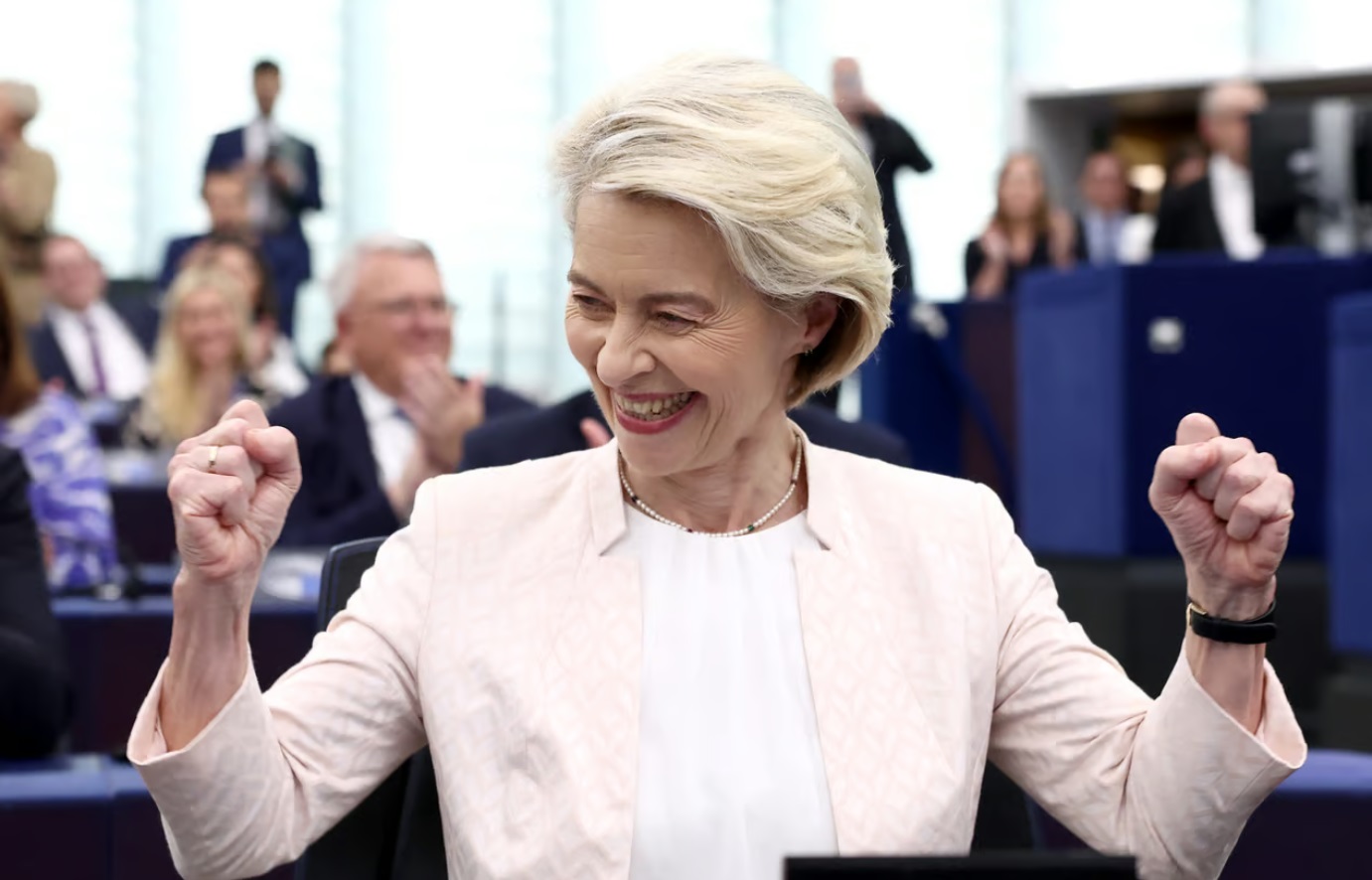
STRASBOURG — Ursula von der Leyen will serve another five years as President of the European Commission, following her approval by EU leaders and Members of the European Parliament (MEPs). However, this marks only the beginning of her challenges. The formidable task ahead is to assemble a team of commissioners, a process complicated by political maneuvering, balancing acts, and the inherent complexities of European Union (EU) politics.
Von der Leyen must now embark on the intricate process of appointing commissioners, whose roles will be critical in shaping EU policies. These decisions will influence how the EU protects its internal market from corporate dominance, strengthens its defense industry in the face of a possible second Trump presidency, and ensures it is on track to become climate-neutral by 2050.
The formal rules appear straightforward: each member country nominates one commissioner. Von der Leyen, representing Germany, and Kaja Kallas, poised to be the next foreign policy chief, representing Estonia, are already in place. At a press conference following her approval, von der Leyen announced that she would request national leaders to nominate both a man and a woman for the roles, except when there is an incumbent commissioner remaining in position. These candidates will be interviewed starting mid-August, and von der Leyen will then assign the portfolios.
In reality, the process is far from simple. Von der Leyen must navigate the treacherous waters of political negotiations, ensuring gender, political, and geographical balance. National leaders will vie for influential positions, each hoping to secure a powerful portfolio. Italian Prime Minister Giorgia Meloni has already publicly stated her expectation that Italy should receive significant recognition in the form of key portfolios when the Commission is constituted.
A notable issue is the irritation among several EU countries regarding von der Leyen’s management style during her first term. Critics, including various EU officials, have accused her and her chief of staff, Björn Seibert, of centralizing decision-making and sidelining both EU governments and commissioners. An anonymous EU official expressed concerns about continued centralization in the next term.
Determined to assert their influence, some EU capitals aim to challenge von der Leyen by carefully selecting who they send to Brussels. An EU diplomat noted that sending two nominees and allowing von der Leyen to choose would increase her power and leverage, something many leaders are wary of.
Some countries, including Finland, Latvia, Ireland, Sweden, Slovenia, and Slovakia, have already publicly declared their sole nominees, demonstrating a refusal to yield to von der Leyen’s request for dual nominations. Irish Taoiseach Simon Harris, for example, firmly stated last month that Finance Minister Michael McGrath is Ireland’s choice for Brussels.
Von der Leyen, however, retains considerable leverage. While each country is guaranteed a commissioner, she decides who receives the prestigious portfolios, such as competition, industrial policy, trade, and enlargement. Conversely, portfolios focused on multilingualism, demography, or foresight are less desirable. Von der Leyen has indicated her intention to introduce new portfolios, including a defense commissioner and roles covering housing, fisheries, and intergenerational fairness. By offering attractive portfolios, she can pressure EU leaders to present two nominees or find alternatives if she disapproves of the initial choices.
Von der Leyen and her team are keen on securing experienced and motivated politicians for these roles. They are not interested in end-of-career politicians or problematic figures national governments might want to offload. Additionally, von der Leyen seeks to simplify the Commission’s structure by reducing the layers from three (executive vice-presidents, vice-presidents, and commissioners) to two.
Despite the best-laid plans, the next five years are unpredictable. Unexpected events, such as the COVID-19 pandemic or Russia’s invasion of Ukraine, can elevate previously overlooked commissioners into pivotal roles. Thus, von der Leyen aims to assemble a robust and dynamic team from the outset.
However, not all aspirations can be fulfilled. High-profile politicians desire major portfolios, and not everyone can be satisfied. A senior EU diplomat remarked on the challenging task ahead, referencing the Berlaymont building where von der Leyen both works and resides while in Brussels, highlighting the complexity of balancing the various demands.
France and Italy are particularly interested in securing influential portfolios related to competition, trade, industry, and economic policy, much to the frustration of more fiscally conservative northern EU governments. Ireland and Luxembourg are eyeing financial portfolios, while Spain aims to secure the energy and climate portfolio for its deputy Prime Minister, Teresa Ribera. Additionally, several European capitals, including the Baltic states and Poland, are hopeful for the enlargement portfolio, which will be crucial in preparing for the potential EU membership of Ukraine, Moldova, and Western Balkan countries.


